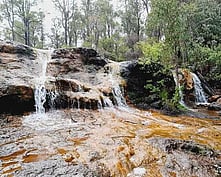
Ironstone FallsIronstone Gully Falls is a 9-meter, seasonal waterfall in Western Australia (17 km southeast of Capel) featuring a small tributary cascading over rich red iron-stone rock.
Capparis spinosa is a prostrate or scrambling shrub which can reach heights of around 1 meter with a spread of up to 3 meters. The plant presents an appealing aesthetic with its thick glossy green leaves, which are oval-shaped, clustered alternately on the stems and can grow up to 10 cm long.
This bush has developed a series of mechanisms that reduce the impact of high radiation levels, high daily temperature, and insufficient soil water during its growing period. The leaves have a waxy texture that helps the plant retain moisture in scorching heat. In response to sudden increases in humidity, the bush forms wart-like pockmarks across the leaf surface. It quickly adjusts to the new conditions and produces unaffected leaves.
The many branched stems are thick and spiny, providing structural uniqueness. Small, curved thorns (stipules) are at the base of the leaf stalks, giving the species its name, spinosa. The flowers are complete, sweetly fragrant, and showy, with four sepals and four white to pinkish-white petals, many long violet-coloured stamens, and a single stigma usually rising well above the stamens.
Flowering occurs in January or March to December, producing an abundance of budding flowers. Its delicate, short-lived flowers look like a floral firework display, blooming for just a single day before fading. After flowering, the distinctive green seed pods form, which eventually turn woody as they mature. Caper Bushes are native to arid and semi-arid climates, preferring full sun and well-drained soils, coastal regions.
They thrive in sandy, gravelly substrates and can tolerate poor nutrient conditions, making them ideal candidates for rocky gardens and coastal landscapes. This shrub grows best in warm climates with minimal frost. Can be propagated through seed or cuttings. Seeds are the main means of propagation and need to be scarified to break their tough coating to encourage germination.
These plants can produce capers for up to 20 years under optimal conditions. The Caper Bush plays a vital role in its ecosystem. It serves as a food source for various insects, including bees and butterflies, contributing to pollination efforts within the environment. Additionally, it helps improve soil quality through its root systems, preventing erosion and retaining water in arid regions. While Caper Bushes are generally hardy, they can be susceptible to pests such as aphids and spider mites. Fungal diseases could affect over-watered plants, leading to root rot. Monitoring and maintaining proper watering and drainage can help mitigate these issues. As Caper Bushes can tolerate extremely hot temperatures they are often a favourite among gardeners looking to create “xeriscapes”—landscapes designed to reduce or eliminate the need for irrigation.
This plant is used for landscaping and can be mass planted as a ground cover and soil stabilizer reducing erosion along highways and on river embankments. Suited for planting on steep rocky slopes, dunes or fragile semiarid ecosystems. As a low spreading shrub, it has good wind tolerance, hardy in coastal areas and has relatively good salt tolerance. Because it develops a very deep, powerful taproot to find water, the Caper Bush is incredibly drought-tolerant once established, relying on minimal water to sustain their growth. However, this also means it absolutely hates being transplanted; once you pot it or plant it, avoid moving it at all costs.